
Accessing Better Financial Opportunities for Healthcare Workers in Nigeria In the Face of Current Economic Realities, Which Way Should Medics Go?

Understanding the Economy
Before we talk about opportunities, we must first ask: what is an economy?
The economy is the system of production, distribution, and consumption of goods and services in a society. In Nigeria today, that system is under pressure—rising inflation, a weakening currency, and high unemployment. And yet, healthcare workers remain at the frontline, often carrying the double burden of professional duty and personal financial survival.
Entrepreneurship: Feasible or a Mirage?
Is entrepreneurship realistic for medics in Nigeria? To answer this, I applied two frameworks:
SWOT Analysis and Porter’s Five Forces.
  • Strengths: A large, underserved population and rising health awareness.
  • Weaknesses: Infrastructure gaps, limited financing, and insufficient financial literacy among medics.
  • Opportunities: Telemedicine, health-tech platforms, diagnostics, pharmaceuticals, training, wellness, and skincare industries.
  • Threats: Instability, quack practices, regulatory challenges, and insecurity.
Porter’s lens also reveals strong patient bargaining power (due to price sensitivity) and supplier pressure (due to dependence on imports). Despite these challenges, entrepreneurship is feasible—if approached with innovation, creativity, and resilience.
One lesson from today’s realities is clear: medics must diversify. Sole reliance on clinical practice is no longer sustainable.
  • Medical Pathways: Telemedicine, health consulting, research grants, medical products, and continuous medical education.
  • Non-Medical Pathways: Stock market participation, treasury bills, forex (with caution), real estate, SMEs, and partnerships in tech startups.
The key is not abandoning medicine, but leveraging downtime, networks, and expertise to create multiple streams of income.
Ethics: The Unshakable Foundation
Now to a sensitive question: in the face of hardship, why shouldn’t a medic overcharge or cut corners?
Because our greatest asset is trust.
Trust and integrity are the currency of healthcare. A single act of unethical behavior can permanently destroy professional reputation.
Instead of shortcuts, medics can:
  • Adopt value-based pricing and explain costs to patients.
  • Improve efficiency by cutting waste and negotiating better with suppliers.
  • Collaborate through group practices to share operational burdens.
  • Enhance financial literacy to avoid desperation-driven mistakes.
Conclusion
Nigeria’s economy is challenging, but it also offers opportunities for those who adapt. For healthcare workers, the way forward is clear:
  • Entrepreneurship is possible, if strategic.
  • Diversification is essential, both within and outside medicine.
  • Ethics remain non-negotiable.
Because no matter how tough the times, patients’ trust is the bedrock of our profession. And with innovation, integrity, and financial wisdom, Nigerian medics will not just survive—they will thrive.
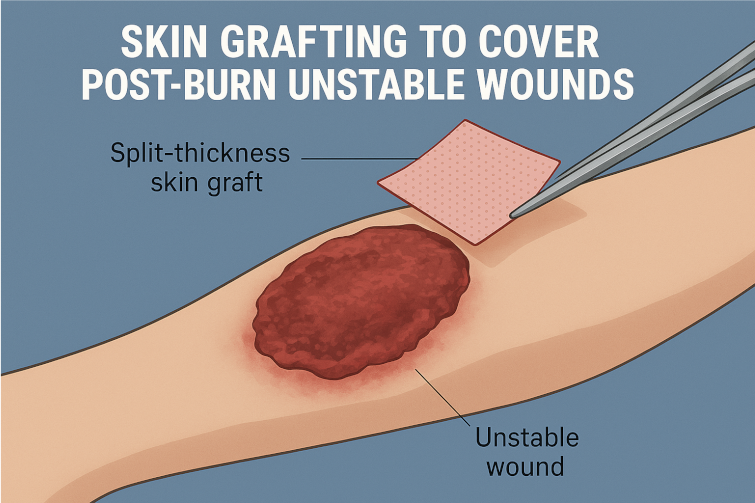
Skin Grafting to Cover Post-Burn Unstable Wounds

Introduction

Post-burn wounds that fail to epithelialize or remain unstable after initial healing can result in chronic ulceration, recurrent breakdown, infection, functional impairment, and cosmetic deformity. Skin grafting remains the cornerstone technique for achieving durable wound closure, restoring barrier function, and enabling rehabilitation.

Indications

Skin grafting is indicated in post-burn patients when:

  • The wound bed is granulating but unstable or prone to recurrent breakdown.
  • There is loss of epidermal and dermal components beyond the skin’s regenerative capacity.
  • Contractures are at risk of developing or have been surgically released.
  • Functional areas (joints, eyelids, perioral regions, perineum) require durable coverage.

Pre-Operative Considerations
1. Wound Bed Preparation
• Adequate debridement of necrotic tissue.
• Control of local infection and exudate.
• Establishment of a healthy, vascularized granulation bed.
2. Systemic Optimization
• Nutritional support (protein, micronutrients).
• Correction of anemia, hypoproteinemia, or dehydration.
• Management of comorbidities (e.g., diabetes, sepsis).

Types of Skin Grafts
1. Split-Thickness Skin Graft (STSG)
• Most common for burn coverage.
• Harvested with a dermatome (0.008–0.015 inches).
• Can be meshed to expand surface area and allow drainage.
2. Full-Thickness Skin Graft (FTSG)
• Provides superior cosmetic and functional outcomes.
• Used for small, functionally critical areas (face, hands, eyelids).
• Donor site requires primary closure.

Operative Technique
1. Donor Site Selection
• Thigh, buttock, abdomen, or back for STSG.
• Postauricular, supraclavicular, or groin folds for FTSG.
2. Harvesting
• Ensure uniform thickness.
• STSG may be meshed (1:1.5 to 1:3 ratio) to increase surface area.
3. Recipient Site Preparation
• Hemostasis must be meticulous—excess bleeding prevents graft adherence.
• Ensure wound bed is healthy, vascularized, and free of infection.
4. Graft Placement
• Secure with sutures, staples, or fibrin glue.
• Apply gentle pressure dressing or negative pressure wound therapy (NPWT) to promote adherence.

Post-Operative Care
• Immobilization of grafted area for 5–7 days.
• Dressings: Non-adherent interface with mild compression.
• Monitoring: Daily observation for hematoma, seroma, infection, or graft displacement.
• Donor Site Care: Usually heals spontaneously within 10–14 days (for STSG).

Outcomes and Complications

  • Successful graft take: 85–95% when bed is optimal.
  • Complications: Partial or total graft loss, hypertrophic scarring, contracture, pigmentary changes.
  • Long-term care: Use of compression garments, physiotherapy, and moisturization to minimize scarring and improve function.

Conclusion

Skin grafting provides reliable, cost-effective, and durable coverage of post-burn unstable wounds. When combined with meticulous wound bed preparation, optimal patient condition, and diligent post-operative care, grafting restores skin continuity, reduces morbidity, and enhances quality of life.